Alberta · Developed pools
Banff Upper Hot Springs
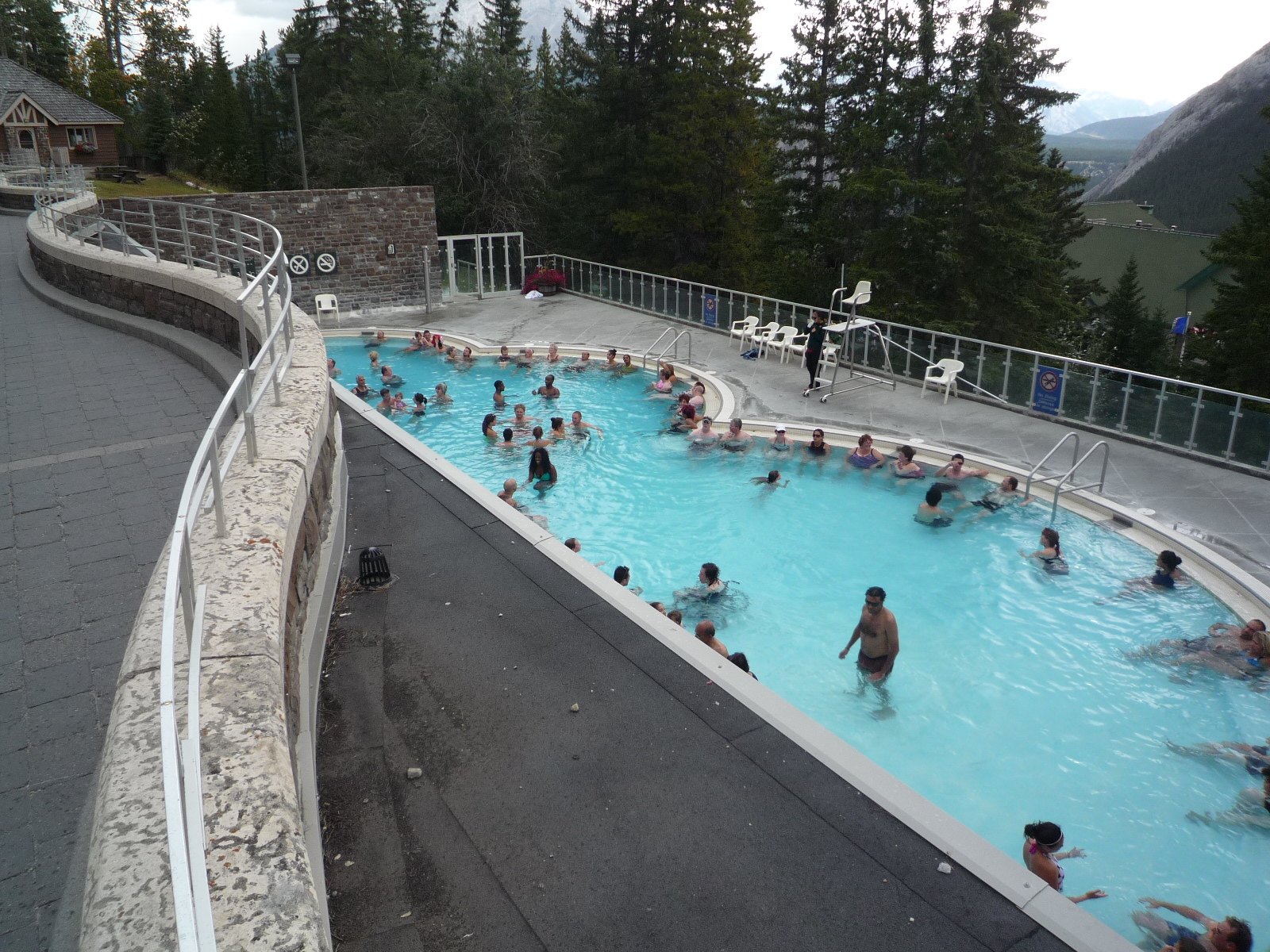
High on Sulphur Mountain, Banff’s outdoor mineral pool pairs a historic bathing tradition with views of the Canadian Rockies. This is a managed pool experience with an established bathhouse, rather than an undeveloped spring in the forest.
Historical source coordinate; not a trailhead. Accuracy and datum have not been independently verified. Historical water readings describe source samples, not safe soaking temperatures.
The springs that created Canada's national parks
Banff's hot water has a claim no other Canadian spring can make. In 1883 three Canadian Pacific Railway workers — William McCardell, Tom McCardell and Frank McCabe — came upon the Cave and Basin springs on the flank of Sulphur Mountain. The dispute over who owned them pushed the federal government to reserve the area, and Banff National Park followed in 1885 as Canada's first.
The springs were not discovered in any meaningful sense. First Nations people had used the Cave and Basin for something on the order of 10,000 years before 1883.
From log shack to 1932 bathhouse
Europeans first reached the Upper Hot Springs, higher on Sulphur Mountain, in 1884. A log shack went up in 1886 alongside the Grand View Villa and its bathhouse, and the site became genuinely popular from 1888 as tourists arrived for the water's supposed health benefits.
The first government facility followed in 1904: two cement plunge basins, a set of bathtubs and a swimming basin about 7.2 metres square. After the Grand View Villa burned in 1931 the federal government took over the lease, and on 1 July 1932 the Upper Hot Springs bathhouse opened with a sulphur-water swimming pool, plunge baths, steam rooms, tubs, showers and dressing rooms — presented at the time as a rival to the great European spas.
What it is today
What survives is a single managed outdoor pool high on Sulphur Mountain with a long view across the Rockies. It is a public facility rather than a wild spring, and it is busy — this is the convenient, scenic, shared soak rather than a solitary one.
The Cave and Basin itself is now a national historic site and is not a bathing pool; it is visited for the history and the cave, not for a swim.
Opening hours & season
Daily 10 am–10 pm; last entry 9:30 pm
Maintenance closure: October 13 to early November 2026. Confirm reopening before travel.
All times are local to the spring. Checked 2026-10-01; this is not a live opening-status display. Closure notices override regular hours.
Our take
An easy fit for a Banff visit when convenience and mountain scenery matter most. Choose it for a classic national-park soak, while expecting a shared public facility rather than solitude.
Editorial assessment based on published information. No firsthand visit or customer score is implied.
Before you go
Sources & record notes
Geoscience BC’s 2016 compilation · 3 historical sampling records · Source name: Upper Hot Springs. References recorded in the dataset: Souther 1973; Mazor 1973; Grasby 2000.
Sources used for this guide
- Wikipedia — Banff Upper Hot Springs
- Wikipedia — Cave and Basin National Historic Site
- Parks Canada — hot springs
- Banff.com — Upper Hot Springs
Written from the published sources above. Operator hours, access rules and closures change; the official link is authoritative.